Best American Schools in Dubai 2026: Fees, KHDA Ratings & AP Results Compared
Here is the reality of choosing an American school in Dubai: only one holds a KHDA Outstanding rating. Only one more has reached Very Good. And yet, for families who want a GPA-based transcript, Advanced Placement courses, SAT preparation, and a pathway built around the way US (and increasingly, Canadian and European) universities actually evaluate applicants, the American curriculum remains the clearest route.
With over 40 American curriculum schools in Dubai — compared to over 100 British schools — the market is smaller, but the variation within it is stark. Annual fees range from under AED 16,000 at community-focused schools in Al Quoz and Al Mamzar to over AED 93,000 at GEMS Dubai American Academy. Some schools employ exclusively US-trained, state-licensed teachers; others staff primarily from the wider MENA region. Some offer the full IB Diploma alongside the US High School Diploma; others stop at a standard diploma with no AP programme at all. And unlike British schools, where GCSE and A-Level results provide a common benchmark, American schools in Dubai vary in which external assessments they use, what data they publish, and whether their diploma even carries accreditation that universities will recognise.
Accreditation is the single most important factor that separates American schools from every other curriculum in Dubai, and it is the one parents most often overlook. A school can call itself American, follow US state standards, and still issue a diploma that top universities will not accept if it lacks accreditation from NEASC, MSA, or WASC.
This guide breaks down all 40+ American curriculum schools in Dubai for the 2026–27 academic year: KHDA ratings, fees by grade level, accreditation status, AP and IB availability, and published academic outcomes. Filter by area, rating, budget, and school phase below — or read on for our editorial take on where the American school market stands right now and where the real value lies.
What's New for American Schools in Dubai in 2026
If you read our British schools guide, you will know that 2026 is a blockbuster year for British school openings — Harrow, Rugby School, and Queen Elizabeth's School are all launching Dubai campuses. The American curriculum market is not seeing the same wave of new entrants. Instead, the story here is about consolidation, government investment, and shifts in accreditation and admissions policy that directly affect how families choose.
The Government-Backed "Dubai Schools" Initiative
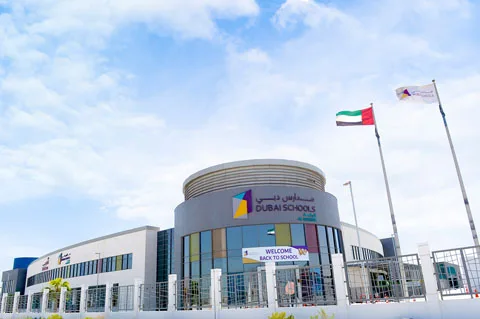
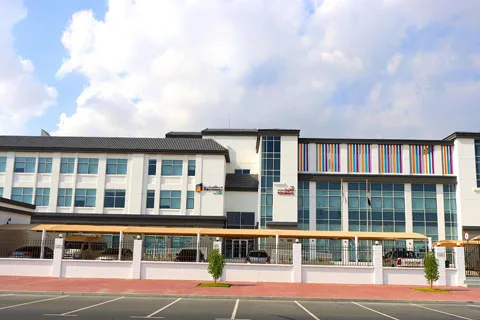
One of the most significant developments for American education in Dubai is the Dubai Schools initiative — a public-private partnership between the Dubai government and Taaleem Education. Three campuses currently operate under this initiative: Dubai Schools Al Barsha (opened 2021), Dubai Schools Mirdif (opened 2021), and Dubai Schools Nad Al Sheba (opened 2022). All follow the American curriculum based on the New York State Education Department (NYSED) standards. These schools are specifically designed to offer high-quality American education at accessible fees, primarily serving Emirati families but welcoming students of all nationalities. Dubai Schools Nad Al Sheba received its first KHDA inspection in 2025 and was rated Acceptable — a common starting point for new schools that are still building their academic track record. The Al Barsha and Mirdif campuses are continuing to add year groups and are expected to be inspected once the KHDA resumes full inspections.
KHDA Ratings Are Frozen — and That Matters More Here
The KHDA's inspection pause (now in its second year, covering 2025–26 and 2026–27) means every rating in this guide dates from the 2023–24 cycle. For American schools, this freeze has a particular consequence: the gap between the top-rated school and the rest was already wide, and there is no mechanism for any school to close it until full inspections resume. Schools rated Good cannot demonstrate improvement to Very Good. Schools rated Acceptable — even if they have made genuine progress — remain labelled as such. The only exception was schools opened in 2022, which received first-time inspections in 2025; Dubai Schools Nad Al Sheba was rated Acceptable through this process.
Parents need to look beyond the headline KHDA rating more than ever. Ask schools for their most recent MAP benchmark data (which all American schools are required to track), internal assessment trends, and self-evaluation reports. These are not published centrally, but good schools will share them on request.
New Admissions Age Cut-Off
From the 2026–27 academic year, the UAE has moved the school admissions age cut-off from August 31 to December 31. Children who turn four by December 31 of the admission year can now join KG1 (the standard entry point for American curriculum schools in Dubai). This is a significant change for families with children born between September and December 2022 — they are now eligible to start KG1 this August, a year earlier than previously allowed. Note that the American curriculum typically starts formal schooling at age four (KG1), one year later than the British curriculum's FS1 entry at age three.
Fee Increases Capped at 2.35%
With inspection ratings frozen, no American school in Dubai can raise fees beyond the KHDA's Education Cost Index of 2.35% for 2025–26, regardless of how well the school is actually performing. This is a levelling mechanism: GEMS DAA, with its Outstanding rating, gets the same cap as an Acceptable-rated school. For parents, it means fee schedules are relatively stable year on year — but always confirm the exact 2026–27 figure directly with the school, as the numbers in this guide reflect the most recently published schedules.
Accreditation Developments
The KHDA requires all American curriculum schools in Dubai to hold accreditation from an approved US accrediting body for their High School Diploma to be considered valid by universities. The three main accrediting bodies recognised are NEASC (New England Association of Schools and Colleges), MSA (Middle States Association of Colleges and Schools), and WASC (Western Association of Schools and Colleges). Ignite School achieved NEASC accreditation in June 2024 — a milestone that confirms its programme meets the standards required for acceptance by US and international universities. Parents should always confirm a school's current accreditation status before enrolling, as this directly affects whether the diploma will be recognised for university admission.
How We Compiled This Guide
American curriculum schools in Dubai are harder to compare than British schools. There is no equivalent of GCSE or A-Level results that every school publishes in a standardised format. Some schools report AP pass rates; others do not offer AP at all. GPA scales vary. IB results are only relevant for the handful of schools that offer the Diploma Programme. To account for this, we layered multiple data sources:
- KHDA's 2023–24 inspection reports for each school's official rating, then cross-referenced published fee schedules from school websites and KHDA fee fact sheets.
- Academic outcomes — AP scores, IB Diploma averages, GPA distributions, SAT data — were gathered where schools have made them public; we flag where data is unavailable, because that silence is itself informative.
- Accreditation status (NEASC, MSA, WASC, CIS, or IBO), since this is a non-negotiable requirement for American schools in a way it is not for British schools.
- EdCare parent community reviews and direct confirmation of admissions details and curriculum pathways from school administrations.
The school listings below default to sorting by KHDA rating (highest first), then fee (lowest first within each tier).
Understanding the American Curriculum in Dubai
The American curriculum is often misunderstood by parents who are more familiar with the structured exam gates of the British system. There are no GCSEs. There are no A-Levels. Instead, the system is built on continuous assessment, a credit accumulation model in high school, and a university application process that evaluates the whole student — not just their exam results on a single day.
Schools in Dubai typically align to a specific US state's learning standards, most commonly New York, California, or Massachusetts. A smaller number use the AERO (American Education Reaches Out) standards, designed specifically for American international schools overseas. While the former Common Core State Standards are no longer implemented as a standalone framework, many of their principles have been absorbed into the individual state standards that Dubai schools now follow.
How the Stages Break Down
Critical Understanding: From Grade 9 onwards, the American system uses a credit-based model: students must accumulate a minimum number of credits across required core subjects (English, maths, science, social studies, physical education, modern languages, arts) and electives to earn their High School Diploma. This is fundamentally different from the British model, where students sit a fixed set of GCSE exams. The credit system gives students more choice and flexibility — but it also means the quality of a school's elective catalogue and AP offerings directly determines how competitive your child's transcript will be for university.
The Testing Journey: What Happens When
One of the most common points of confusion for parents new to the American system is the sheer number of standardised tests — and when each one matters. Unlike the British curriculum, where the assessment calendar is anchored to two clear milestones (GCSEs at 16, A-Levels at 18), the American system layers multiple assessments across the years, each serving a different purpose.
| Grade Level | Assessment | What It Is For |
|---|---|---|
| KG2 – Grade 9 | MAP Testing (3x per year) | Internal benchmarking. Tracks your child's growth in reading, maths, and language usage against US national norms. Schools use MAP data to identify strengths and gaps, set targets, and report to the KHDA. |
| Grade 8–9 | PSAT 8/9 | Early readiness indicator. Measures literacy and maths skills against the benchmarks students will need for the SAT. Not used for university admission. |
| Grade 10 | PSAT 10 / PSAT NMSQT | SAT warm-up. The PSAT 10 mirrors the SAT format at a slightly lower difficulty level. The NMSQT version can qualify US-national students for National Merit Scholarships. |
| Grade 11 | SAT or ACT | University admissions and UAE equivalency. The SAT is the high-stakes standardised test in the American system. A minimum SAT Maths score of 440 is currently required for Ministry of Education equivalency. |
| Grade 11–12 | AP Exams (May) | College credit and competitive differentiation. Scores of 3–5 (out of 5) can earn university credit in the US and are viewed favourably by admissions committees worldwide. |
| Grade 12 | TOEFL / IELTS | English language proficiency. Required by some universities (particularly in the UK, Europe, and for UAE equivalency) even for students educated in English-medium schools. |
MAP testing is the engine that runs beneath the surface from KG2 through Grade 9, quietly building the data profile that informs everything from parent-teacher conferences to KHDA inspections. The SAT is the single most consequential external exam your child will take. And AP exams are the optional accelerant that separates a solid transcript from a competitive one.
Key Differences from the British Curriculum
Parents who are comparing American and British schools in Dubai should understand several structural differences:
- The American system starts formal academics one year later (KG1 at age four vs FS1 at age three in British schools).
- It uses a credit-based system in high school rather than a fixed exam schedule like GCSEs and A-Levels.
- Assessment is continuous throughout the year (GPA-based) rather than weighted heavily toward final exams.
- The American system typically requires students to study a broader range of subjects through to Grade 12, while the British A-Level system narrows to three or four subjects in the final two years.
- US university applications consider the whole student — GPA, AP scores, SAT/ACT, extracurriculars, essays, and recommendation letters — rather than being primarily exam-result driven.
Accreditation: Why It Matters
For a US High School Diploma issued in Dubai to be recognised by universities worldwide, the school must be accredited by an approved US accrediting body. The three main bodies are NEASC, MSA, and WASC. Without accreditation, the diploma may not be accepted for university admission — particularly in the US, Canada, and the UK. Accreditation also matters for the UAE Ministry of Education equivalency process, which typically requires a valid accredited diploma, a minimum SAT Maths score (currently 440), and TOEFL/IELTS scores. Always verify a school's accreditation status directly before making an enrolment decision.
American Schools in Dubai: Key Facts for 2026
Fee Tiers: Where the Money Goes (and Where It Doesn't)
The American school market in Dubai has a peculiar shape. At the top, you have two or three schools charging AED 80,000–93,000 and delivering genuinely premium outcomes. At the bottom, you have schools under AED 20,000 that offer an accredited diploma at a fraction of the cost. And in between sits a mid-range tier where — arguably — parents get the most interesting value for money, because several of these schools punch well above their fee bracket on KHDA ratings and accreditation.
Schools in this bracket include the most established and highest-rated American school brands in Dubai.
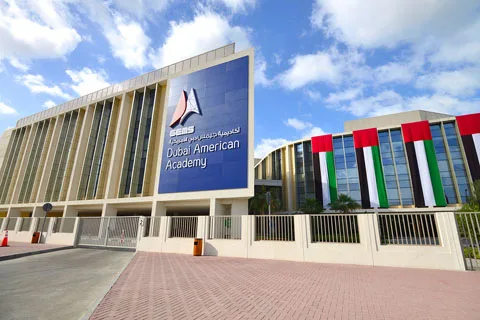
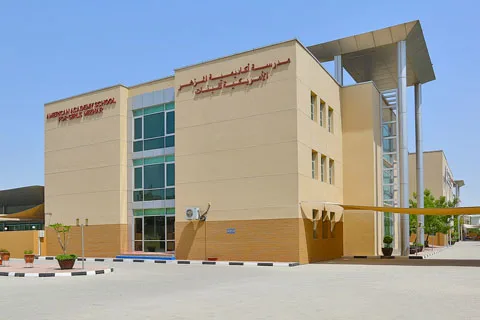
- GEMS Dubai American Academy (AED 66,185–93,300) — Only KHDA Outstanding rated American school, IB Diploma offered, consistently above-global-average IB scores
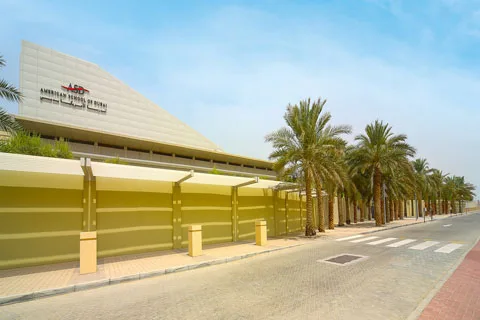
- American School of Dubai (AED 60,571–89,319) — Founded 1966, not-for-profit, college-preparatory with AP courses
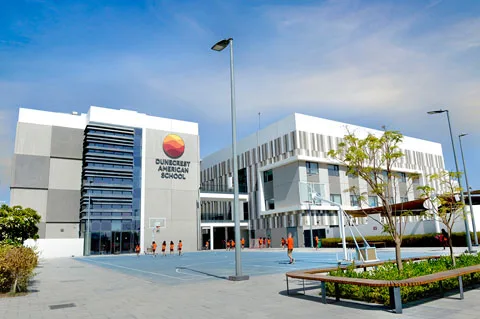
- Dunecrest American School (AED 41,500–90,050) — Purpose-built 8.5-acre campus near Al Barari
- Clarion School (~AED 94,680 at high school) — Progressive American school in Al Quoz
⚡ Waitlists common, particularly for KG1 and Grade 6 entry.
This segment includes schools that often punch above their fee bracket.
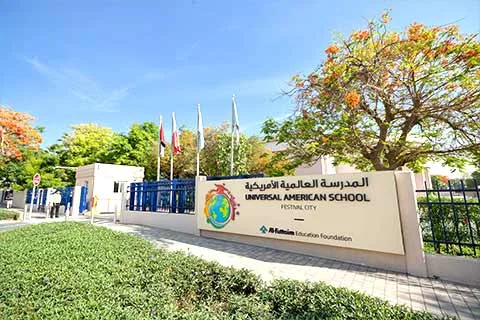
- Universal American School (AED 39,450–81,021) — Only KHDA Very Good-rated American school in affordable range, not-for-profit, triple accreditation (MSA, CIS, IBO)
- Collegiate International School (AED 39,478–70,630) — 1:6 student-to-teacher ratio, multiple pathways (IB, AP, US Diploma)
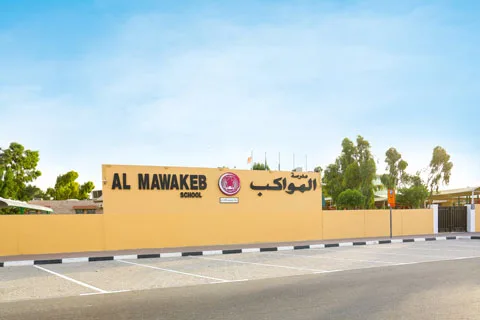
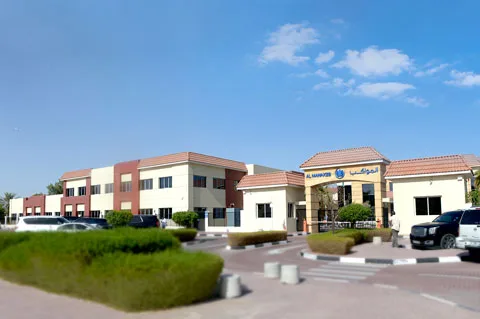
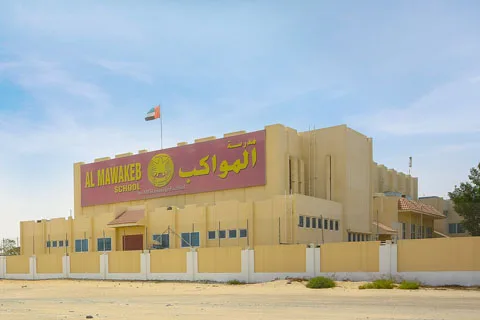
- Al Mawakeb Schools (~AED 15,365–68,004) — California State Standards, multiple campuses
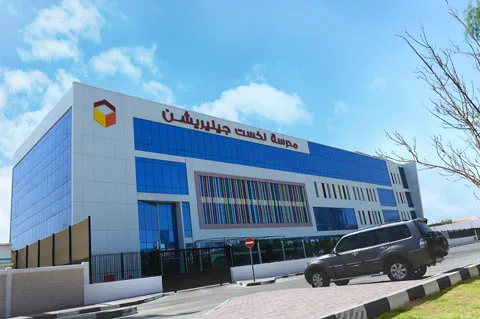
- Next Generation School (AED 28,714–44,968) — American Common Core + Islamic education
⭐ KHDA ratings range from Good to Very Good.
Several American curriculum schools with fees below AED 25,000.
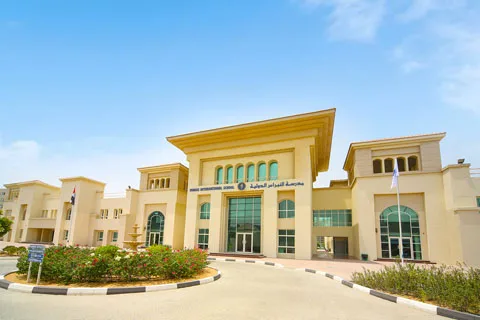
- Dubai International Private School (from AED 15,607) — Lowest fees of any accredited American school, operating since 1985
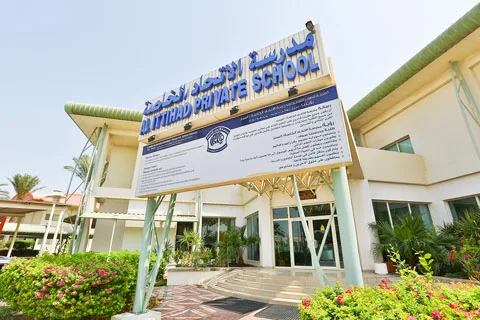
- Al Ittihad Private School (from AED 18,207) — Strong Arabic/Islamic values, separate sections for boys/girls from Grade 5
- International City, Al Muhaisnah, Al Qusais schools — Starting from ~AED 7,000–15,000 at lower grades
💰 Trade-offs in facilities and extracurriculars, but core diploma pathway remains intact.
What Actually Matters When Picking an American School in Dubai
Parents transferring from the British school world — or arriving fresh from the US, Canada, or elsewhere — often apply the wrong filters when evaluating American schools in Dubai. KHDA rating matters, but it tells a different story for this curriculum. Here is where to focus your shortlisting energy.
KHDA Rating — Read the Report, Not Just the Grade
Unlike the British curriculum sector where 14 schools hold the Outstanding rating, the American curriculum has exactly one: GEMS Dubai American Academy. Universal American School stands alone at Very Good. The rest — the vast majority — sit at Good or Acceptable. This does not mean American schools are inherently weaker. It reflects the smaller pool size and, critically, the KHDA's inspection criteria, which include Arabic and Islamic studies performance. Many American schools with strong English, maths, and science outcomes see their overall rating pulled down by developing Arabic results — a subject where British schools face the same challenge but have more room to absorb it statistically across 14 Outstanding peers.
Do not dismiss a Good-rated American school without reading the full inspection report. Look at the subject-by-subject breakdown and the phase-specific ratings (Kindergarten, Elementary, Middle, High). A school rated Good overall but Very Good in your child's phase and in the subjects that matter to your family may be a better fit than a higher-rated school with larger class sizes or fewer AP options.
Academic Outcomes — The Transparency Problem
One of the biggest frustrations for parents comparing American schools in Dubai is the lack of a universal results benchmark. British schools have GCSEs and A-Levels — standardised, externally assessed, and published. American schools have no equivalent. Each school may track different metrics, publish different data, or publish nothing at all. Here is what to look for and what it means when a school does not share it:
For American curriculum schools, the most relevant academic measures are:
- GPA Distributions: The percentage of students achieving above 3.75 or 4.0 GPA. The American School of Dubai reports close to 15% of students with a GPA above 4.0 and over 30% in the 3.75–3.99 range.
- AP Scores: The number of AP courses offered and the percentage of students scoring 3 or above (the threshold most US universities consider for credit). Not all American schools in Dubai offer AP courses — this is itself a signal worth noting.
- IB Diploma Results: For schools offering the IB alongside the US curriculum (GEMS DAA, Universal American, Collegiate International), the average IB points score and pass rate. GEMS DAA's Class of 2024 averaged approximately 34 points with a 97% pass rate against the global average of 30.3 points and 80% pass rate.
- SAT Scores: Some schools publish average SAT scores, which are required for UAE Ministry of Education equivalency and useful for US university applications.
- University Destinations: Where graduates are accepted — top-tier US, UK, and global university placements indicate the quality of the school's college counselling and academic preparation. GEMS DAA reports placements at Princeton, Columbia, Johns Hopkins, UCL, and McGill among others.
Location — American Schools Cluster Heavily in the West
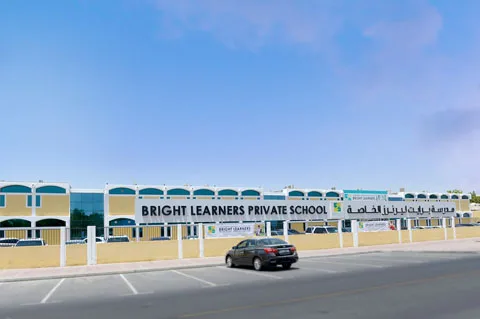
Unlike British schools, which are spread across virtually every neighbourhood in Dubai, American schools are concentrated. The Al Barsha corridor alone has five or six options within a few kilometres — GEMS DAA, American School of Dubai, Next Generation School, Al Mawakeb Al Barsha, and Dubai Schools Al Barsha. Dubai Festival City houses Universal American School. If you live in eastern Dubai, your choices narrow to Al Mawakeb Al Khawaneej, Mirdif American School, Dubai Schools Mirdif, Bright Learners (Al Rashidiya), and Ignite School (Al Warqa). The central Al Quoz area is served by Dubai International Private School and Clarion School. If your commute tolerance is under 30 minutes, geography may narrow the list to three or four realistic options before you even consider ratings or fees.
Watch Out for Schools That Do Not Go to Grade 12
Most American curriculum schools in Dubai run KG through Grade 12, which is an advantage — no forced transition at age 11 the way the British system sometimes requires. But there are exceptions. Mirdif American School stops at Grade 8. The Dubai Schools campuses are still adding grades year by year and do not yet offer the full high school programme. Clarion School is also still expanding its upper grades. If continuity through graduation matters, confirm that the school offers Grades 9–12 before you enrol, and ask specifically about AP and diploma pathway availability at the high school level — some schools that nominally go to Grade 12 offer very limited AP subject choices compared to the premium tier.
The Grade 11–12 Decision: Standard Diploma, AP, or IB?
This is where the American curriculum conversation in Dubai gets genuinely interesting — and where the difference between a AED 20,000 school and a AED 90,000 school becomes most tangible. There are three pathways available, and not every school offers all of them:
American vs British Curriculum: A Quick Comparison for Dubai Parents
Many families arriving in Dubai are deciding between American and British curriculum schools. Here is a practical comparison:
| Factor | American Curriculum | British Curriculum |
|---|---|---|
| Entry age | KG1 at age 4 | FS1 at age 3 |
| Structure | KG–Grade 12 (credit-based) | FS1–Year 13 (stage-based with external exams) |
| Key external exams | SAT, AP exams (optional but recommended) | GCSEs (Year 11), A-Levels (Year 13) |
| Assessment style | Continuous (GPA across all four high school years) | Weighted toward terminal exams |
| Subject breadth at 16–18 | Broad: 6–8 subjects through Grade 12 | Narrow: 3-4 A-Level subjects |
| University application | Holistic: GPA + SAT + AP + essays + extracurriculars | Primarily exam-based: predicted/actual A-Level grades |
| Best suited for | US, Canadian, and some European university applications | UK university applications (UCAS system) |
| Schools in Dubai | 40+ | ~105 |
| Outstanding KHDA schools | 1 | 14 |
| Fee range | AED 7,000–93,300 | AED 7,000–118,000 |
Both curricula are well-regarded by universities worldwide, and some Dubai schools offer both (e.g., US curriculum with IB Diploma option, or British curriculum with IB Diploma option). The best choice depends on where your child is most likely to apply for university and which assessment style suits their learning.
Frequently Asked Questions
There are over 40 schools in Dubai offering the American (US) curriculum. This makes it the third most widely offered curriculum in the emirate, after British (approximately 105 schools) and Indian.
Several American curriculum schools in Dubai offer annual fees starting from approximately AED 7,000–16,000 at the Kindergarten level. Dubai International Private School has some of the lowest published fees for a KHDA-regulated, accredited American school, starting from AED 15,607 for KG.
GEMS Dubai American Academy has the highest published fees among established American schools, at AED 93,300 per year for Grades 1–12. Clarion School reaches approximately AED 94,680 at the high school level. Dunecrest American School reaches approximately AED 90,050 for its highest grade levels.
As of the 2023–24 inspection cycle, only one American curriculum school holds the KHDA Outstanding rating: GEMS Dubai American Academy. It has held this rating uninterrupted since 2011 — making it one of the most consistently high-performing schools of any curriculum type in Dubai.
Universal American School in Dubai Festival City holds the KHDA's Very Good rating — the second-highest tier. It operates as a not-for-profit school under the Al Futtaim Education Foundation and offers a blended US/IB curriculum.
The KHDA paused full inspections for the 2025–26 and 2026–27 academic years. All ratings shown are from the 2023–24 inspection cycle, with the exception of schools opened in 2022 (such as Dubai Schools Nad Al Sheba), which received their first ratings in 2025. Schools continue to be monitored through self-evaluations and targeted visits.
From the 2026–27 academic year, the age cut-off has moved from August 31 to December 31. Children who turn four by December 31 of the admission year can now start KG1 in August/September. For American curriculum schools, this is particularly relevant because KG1 (age four) is the standard entry point — not Pre-KG (age three), which not all schools offer.
Yes. The KHDA requires all American curriculum schools to hold accreditation from a recognised US accrediting body (NEASC, MSA, or WASC) for their High School Diploma to be considered valid. This is essential for university admission both in the US and internationally. Always verify a school's accreditation status before enrolling.
Advanced Placement (AP) courses are individual college-level classes within the American system, assessed by the College Board. Students can take as many or as few as they choose. The IB Diploma Programme is a comprehensive two-year programme requiring study across six subject groups plus additional core components. Some Dubai American schools offer both, giving students flexibility. AP is more modular and suits students who want to specialise; the IB Diploma is broader and particularly valued for non-US university applications.
Common assessments include MAP (Measures of Academic Progress) for ongoing benchmarking from KG2 onwards, PSAT 8/9 and PSAT 10 for high school readiness, the SAT for university admissions and UAE equivalency, and AP exams for students enrolled in AP courses. Some schools also require TOEFL or IELTS for students applying to universities where English language proficiency must be demonstrated.
Yes, and this is relatively common in Dubai. The main adjustment is moving from the year-group system to the grade-level system and adapting to continuous GPA-based assessment rather than terminal exams. Most American schools will assess transferring students and may require placement tests. The earlier the transition, the smoother the adjustment — transferring before Grade 9 is generally recommended to allow enough time to build a strong four-year high school transcript.
Dubai Schools is a public-private partnership initiative between the Dubai government and Taaleem Education. Three campuses currently operate — in Al Barsha, Mirdif, and Nad Al Sheba — all following the American curriculum based on New York State Education Department standards. These schools are designed to offer quality American education at accessible fees, primarily serving Emirati families but open to all nationalities.
The American curriculum is not seeing the same wave of new school openings as the British curriculum in 2026 (where Harrow, Rugby School, and Queen Elizabeth's School are all launching). The most notable recent development is the continued expansion of the Dubai Schools campuses, which are adding new grade levels each year. Parents seeking new American-curriculum options may also wish to watch for announcements from GEMS Education and other operators, as the KHDA's Education 33 strategy envisions significant school capacity expansion across all curricula through 2033.